

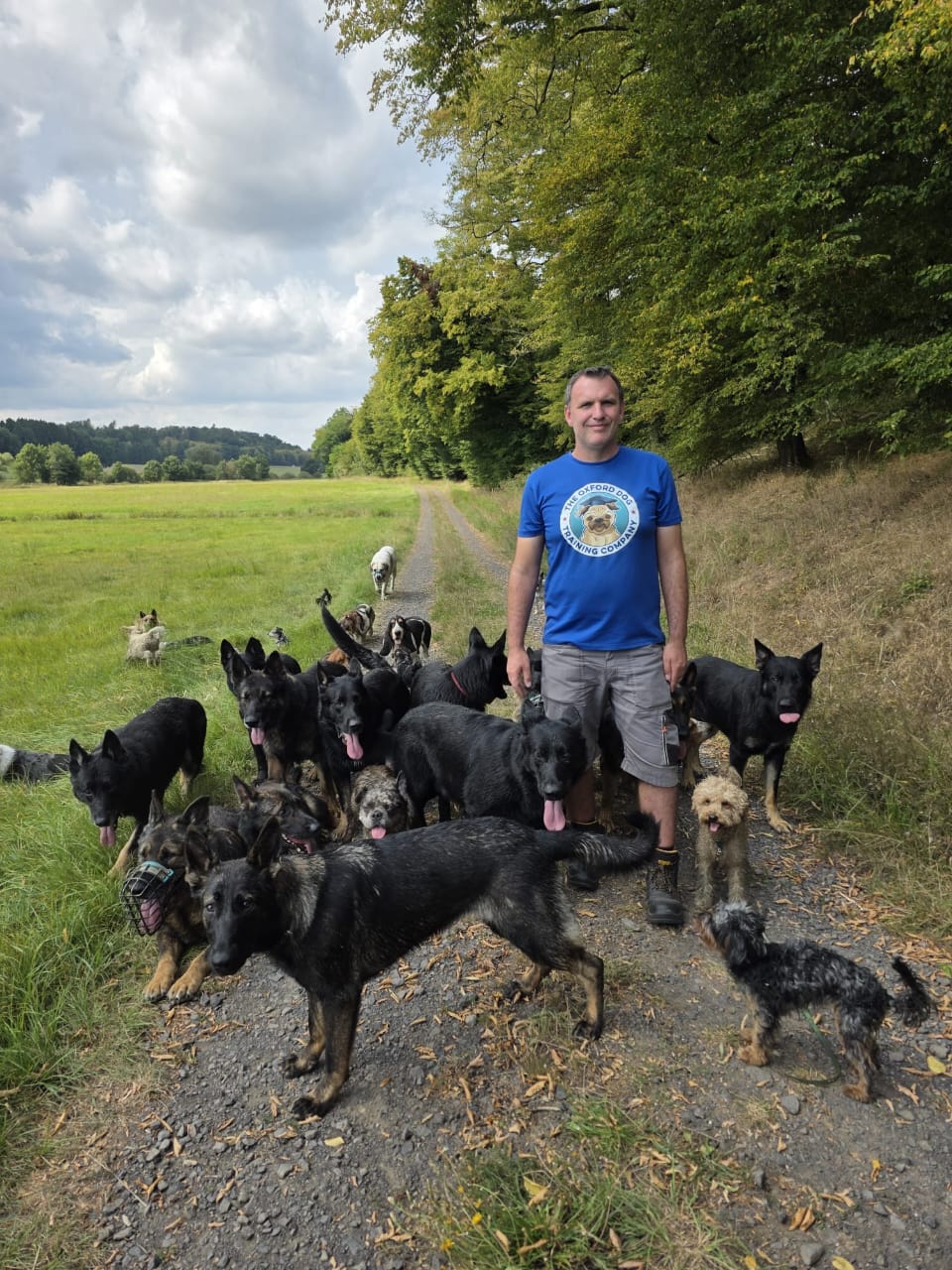
By Anthony Thomas, Head Behaviourist – The Oxford Dog Training Company
Most dog owners have heard the claim that dogs behave like wolves, often followed by advice about dominance, pack order, or the need to be an “alpha.” Others insist that dominance is outdated and irrelevant. It is no surprise that people feel unsure about what to believe.
This debate traces back to two key scientific observations. In 1947, Rudolf Schenkel studied wolves living in captivity and recorded frequent aggression, tension, and competition for rank. He concluded that wolves lived in strict dominance hierarchies led by an alpha.
Decades later, wolf biologist David Mech studied wolves in the wild and found something entirely different. Wild wolves lived as families, with adult wolves acting as parents caring for their pups. They were not locked in constant battles for power.
Faced with two opposing pictures, many trainers dismissed dominance theory altogether. However, the full truth lies somewhere in between.
Dogs Don’t Live Like Wild Wolves
Your dog does not live in a wild wolf family. They live in a human household, which can be described as a forced pack. Their daily structure is dictated by human routines, often shared with unrelated dogs, limited freedom, and shared resources.
In this context, their environment is more similar to the captive wolves Schenkel studied than to the stable family groups Mech observed. In forced packs, disagreements and informal hierarchies are a natural result of the artificial living arrangement.
Schenkel was not wrong about what he saw; he was simply studying wolves in an unnatural setting. Recognising this helps us understand our own dogs more accurately.
Parent, Not Alpha
The essential point is that dogs are not wolves. They are paedomorphic, which means they retain certain juvenile wolf traits throughout their lives. As a result, their behavioural needs align more closely with those of adolescents than adult wolves.
Because of this, dogs do not need an alpha. They need a parent figure.
A parent provides boundaries.
A parent offers structure and emotional safety.
A parent guides without intimidation or force.
The terminology is less important than the tone of the relationship. Dogs thrive under calm, consistent humans who offer stability.
Why This Matters for Training
Cesar Millan popularised the idea of “calm, assertive leadership,” and although many of his techniques have been criticised, the concept resonated with people for a reason. Dogs respond well when humans act with clarity and calm confidence.
Today, behavioural science offers a more humane and informed version of that idea.
Dopamine supports learning and motivation.
Oxytocin strengthens bonding and trust.
Parental-style leadership creates security within the forced pack of a human household.
Together, these components produce an environment that avoids both harsh dominance and permissive chaos. Dogs flourish when they have clear rules, consistent guidance, and emotional safety.
This helps explain why Millan’s core message reached so many people. It reflected what many were already experiencing at home: dogs need humans to be steady and predictable.
Final Thoughts
Dogs do not live in behavioural theories. They live in our homes, sharing our lives and our emotional environments. To thrive, dogs need three essential things: the joy of learning supported by dopamine, the connection created by oxytocin, and the safety offered by parental-style guidance.
So perhaps the real question is not whether you should act like an alpha. The better question is whether you are providing the kind of parenting your dog truly needs.